

You've had an ache in your testicles for weeks or months. You saw a doctor. Maybe you had an ultrasound, a urine test, a round or two of antibiotics. Everything came back "normal" — but the pain didn't go away.
If that sounds familiar, you're not alone, and you're not imagining it. One of the most overlooked causes of ongoing testicular pain in men is the pelvic floor: a group of muscles most men have never heard of, let alone had checked. The low back, the abdominal muscles, and the nerves that travel from your spine to your groin are often part of the story too.
In this post, we'll explain how your pelvic floor, low back, abdominal muscles, and nerves can cause testicular pain, what else tends to come with it, and how men's pelvic floor physical therapy helps.
First: when testicular pain is an emergency
Some testicular pain needs medical care right away. Go to the ER immediately for:
Sudden, severe pain in one testicle, especially with swelling, nausea, or vomiting — this can be testicular torsion, where the blood supply is cut off and hours matter
Pain after a significant injury to the groin
See a doctor promptly for:
A new lump, hardness, or change in the size or shape of a testicle
Fever, redness, or warmth in the scrotum
Burning with urination, discharge, or blood in your urine or semen
A bulge in the groin that gets bigger when you cough or strain
Pelvic floor therapy is for pain that has been medically checked, especially when tests haven't found a clear cause.
How the Pelvic Floor, Back, and Nerves Cause Testicular Pain
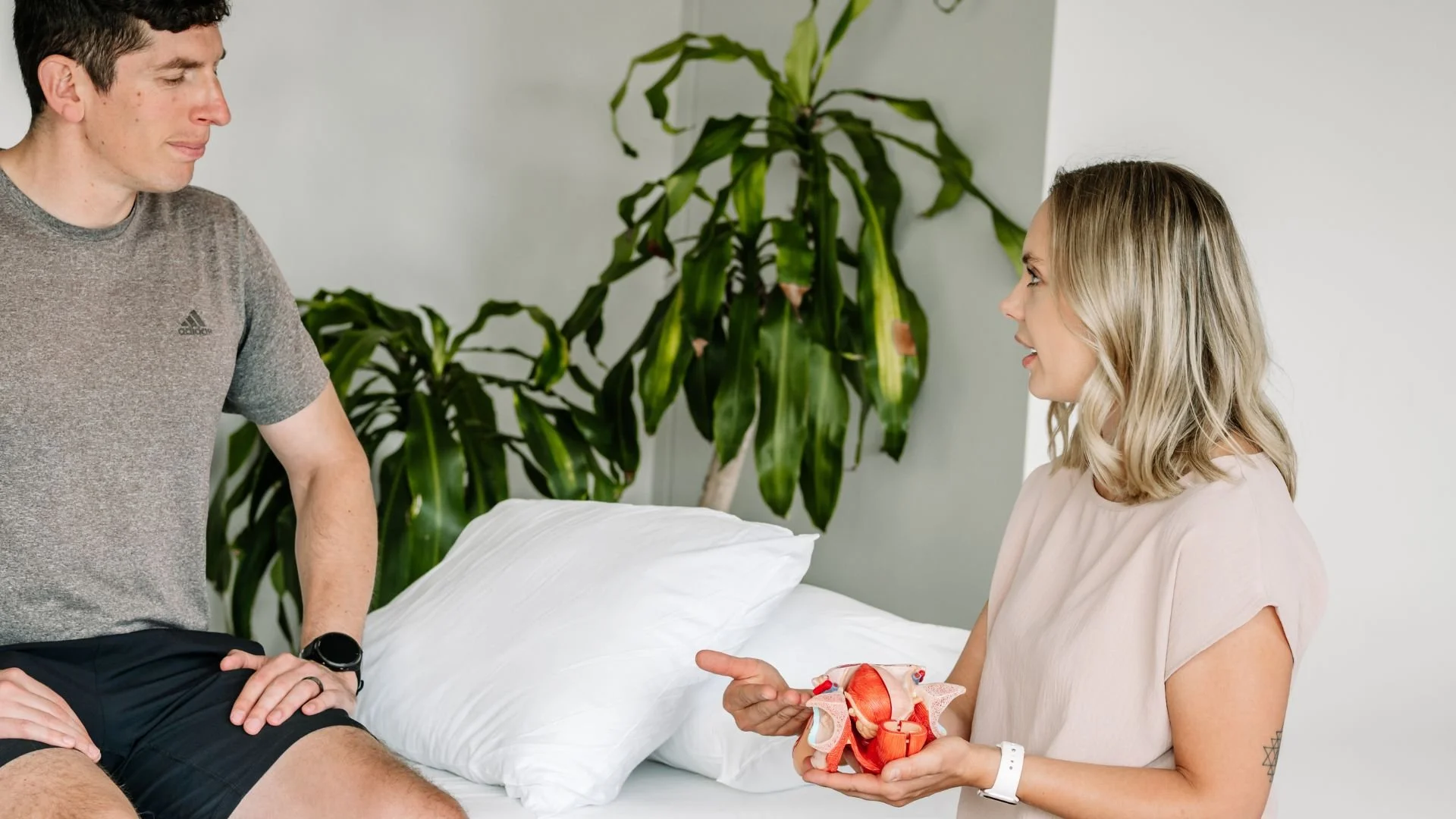
Men have a pelvic floor too. It's a sling of muscles at the base of the pelvis, running from the pubic bone to the tailbone. It supports your bladder and bowel, helps control urination and bowel movements, and plays a key role in erections and ejaculation.
When these muscles get chronically tight, they can develop trigger points — tender knots that send pain to other areas. Trigger points in the pelvic floor, inner thighs, abdomen, and glutes can refer pain into the testicles, penis, perineum, and groin. Nearby nerves, like the pudendal, ilioinguinal, and genitofemoral nerves, can also get irritated by tight tissue, adding burning or aching to the mix.
It's not just the pelvic floor: your low back, abdomen, and nerves
The nerves that supply the testicles, scrotum, and groin start in your spine, at the junction of the mid and low back. From there they travel around the trunk, through or between the back and abdominal muscles, and down into the groin. These include the ilioinguinal, iliohypogastric, and genitofemoral nerves.
That long path gives pain several places to start:
A stiff or irritated low or mid back. Joints and tissues where these nerves exit the spine can send pain along the nerve and into the testicles, even when your back itself doesn't hurt much.
Tight back muscles. Muscles like the quadratus lumborum, the deep spinal muscles, and the psoas (a hip flexor that runs along the spine) can compress or irritate the nerves along their path.
Tight abdominal muscles. The obliques and deep abdominal wall muscles sit right where these nerves travel toward the groin. Constant bracing, heavy core training, or scar tissue from a hernia repair or other surgery can squeeze them.
So pain you feel in your testicles may actually be driven by your back, your abdomen, your pelvic floor, or all three. That's why we assess the whole chain, not just the spot that hurts.
Chronic pelvic pain syndrome ("prostatitis" without infection)
Many men with ongoing testicular pain are eventually told they have chronic prostatitis. But in most cases, there's no infection at all. The condition is now called chronic prostatitis/chronic pelvic pain syndrome (CP/CPPS), and experts increasingly recognize that the prostate often isn't the source of the pain.
It's more common than most men realize. Studies estimate that prostatitis-like symptoms affect somewhere around 2% to 16% of men, with a median of about 7%. In a review of more than 1,500 men with CP/CPPS, testicular pain was the second most common symptom, reported by 58% — just behind perineal pain at 63%.
Pelvic floor muscle tension is a big part of the picture. In one study, 51% of men with prostatitis symptoms had pelvic muscle tenderness, compared to only 7% of men without symptoms.
Symptoms that often come along with it
A dull ache, heaviness, or burning in one or both testicles
Pain in the perineum (between the scrotum and anus), penis tip, groin, or lower abdomen
Pain that's worse with sitting and better standing or lying down
Pain during or after ejaculation
Urinary frequency, urgency, a weak stream, or a feeling of not fully emptying
Constipation or pain with bowel movements
Erectile changes
If several of these sound familiar, the pelvic floor is worth evaluating — especially if antibiotics didn't help.
What Makes the Pelvic Floor Tighten Up in Men?
There's rarely one single cause. Common contributors we see include:
Long hours of sitting at a desk, in a truck, or in a car
Cycling, spin, and heavy lifting with lots of breath-holding and bracing
Constipation and straining on the toilet
Stress and anxiety. Many men unconsciously clench their pelvic floor under stress, the same way others clench their jaw or shoulders
A past infection, injury, or surgery, such as a hernia repair, vasectomy, or prostate procedure, after which the muscles stay guarded
Low back stiffness, tight back or abdominal muscles, or hip and groin issues that change how the pelvis moves
Holding urine for long stretches at work
Once pain starts, it tends to feed itself. Pain makes the muscles guard, guarding creates more pain, and worry about what's wrong tightens things further. Breaking that cycle is a big part of treatment.
How Pelvic Floor Physical Therapy Helps Testicular Pain
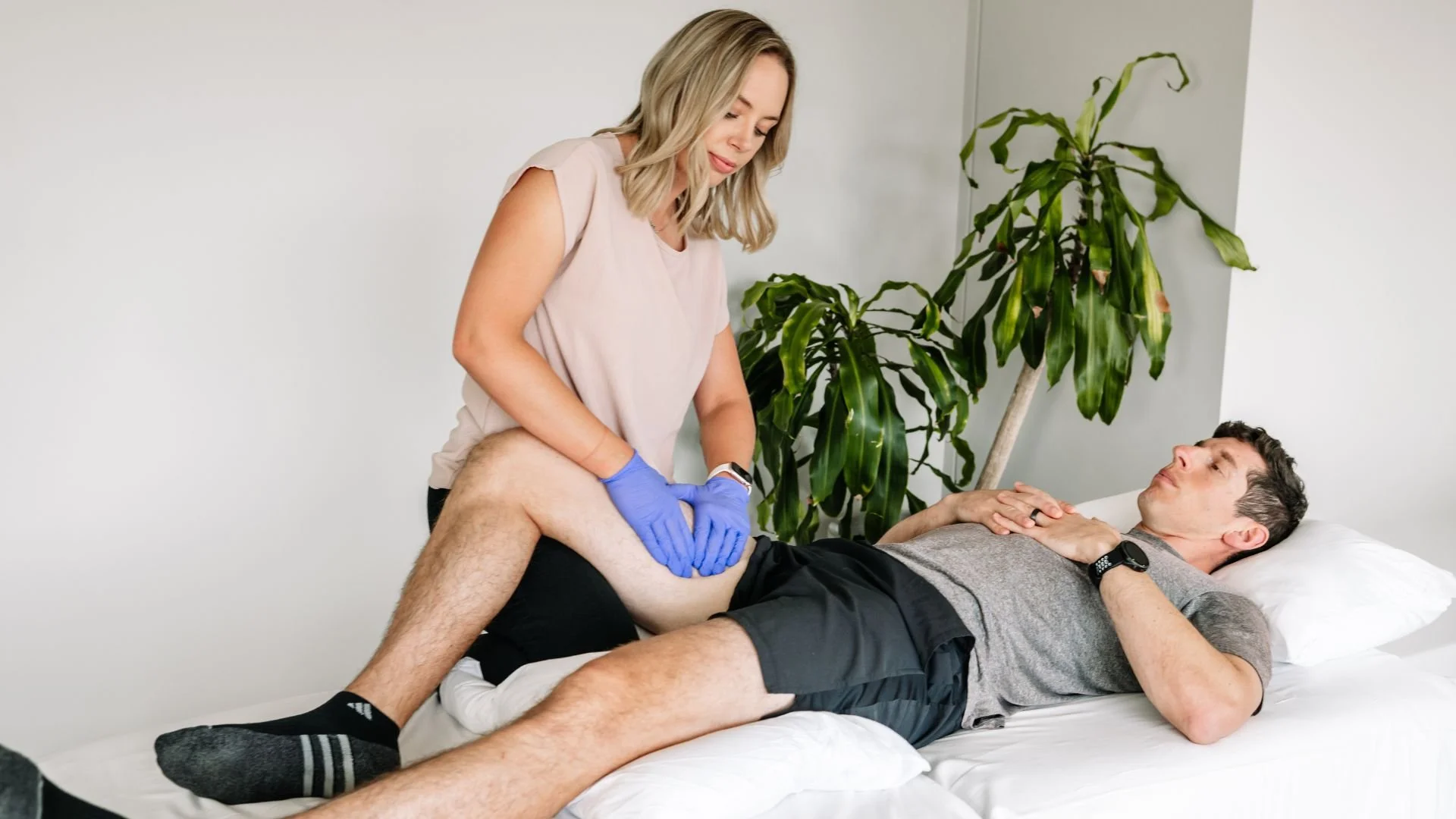
Pelvic floor physical therapy is one of the best-supported non-drug treatments for CP/CPPS and pelvic floor–related testicular pain. Our Doctors of Physical Therapy treat men regularly, and every session at Awake is a full hour, one-on-one, in a private room.
What to expect at your first visit
A straightforward conversation. We'll ask about your pain, urination, bowel habits, sexual function, work, exercise, and stress. Nothing you share will be awkward for us.
A movement and posture assessment, fully clothed, looking at your hips, back, breathing, and core.
An external exam of your low and mid back, plus the muscles around your hips, abdomen, inner thighs, and groin.
An optional internal exam. For men, the pelvic floor is assessed through the rectum with one gloved finger. It's the most accurate way to find trigger points that reproduce your testicular pain. It's always your choice, and we can start externally if you prefer.
A clear plan and your first treatment.
What treatment may include
Internal and external trigger point release to calm the specific muscles referring pain to your testicles
Myofascial release, dry needling, and cupping for the low back, abdominal wall, psoas, inner thighs, glutes, and hips, plus spinal mobility work for a stiff mid or low back
Pelvic floor down-training. Most men with this kind of pain need to learn to relax the pelvic floor, not strengthen it. Kegels often make it worse.
Breathwork and nervous system calming to break the stress-tension-pain cycle
Nerve mobility work for the nerves that travel from your low back to the groin and scrotum
Bladder and bowel strategies to stop straining and urgency from aggravating symptoms
A return-to-activity plan for lifting, cycling, and sitting at work
We also coordinate with your urologist or primary care provider. Pelvic floor therapy works well alongside medical care, and we'll refer you back if anything needs further medical evaluation.
Learn more about our Men's Health Physical Therapy and Pelvic Pain Physical Therapy. If constipation is part of your picture, read Breaking Free from Constipation.
Testicular Pain & Men's Pelvic Floor FAQs
Can a tight pelvic floor cause testicular pain?
Yes. Trigger points in the pelvic floor and nearby muscles can refer pain to the testicles, and tight tissue can irritate nerves that supply the scrotum and groin.
Why do I have testicular pain when tests are normal?
Ultrasounds and urine tests look for problems like infection, torsion, hernias, or tumors. They don't assess muscle tension or trigger points, which is why pelvic floor causes are often missed.
Can low back problems cause testicular pain?
Yes. The nerves that supply the testicles and groin start in the spine where the mid and low back meet. A stiff or irritated back, or tight back and abdominal muscles along the nerves' path, can refer pain into the testicles.
Is chronic prostatitis the same as an infection?
Usually not. Most men diagnosed with chronic prostatitis have chronic prostatitis/chronic pelvic pain syndrome (CP/CPPS), which has no infection. That's why repeated antibiotics often don't help.
Do men really go to pelvic floor therapy?
Yes. Pelvic floor therapy helps men with pelvic and testicular pain, urinary symptoms, leaking after prostate surgery, and sexual concerns. Our team treats men regularly.
Is the internal exam required for men?
No. A rectal assessment gives the most information, but it's always optional, and we can do plenty of effective work externally.
Should I do Kegels for testicular pain?
Usually not. Most men with pelvic floor–related pain have muscles that are already too tight. Kegels can make symptoms worse. A pelvic PT can tell you which approach fits your body.
How long does it take to feel better?
It varies, especially if pain has been around for a long time. Many men notice changes within the first several visits, and we'll set clear goals at your first appointment.
Men's Pelvic Floor Therapy in Woodbury, MN
Ongoing testicular pain is frustrating, and it's easy to feel brushed off when every test comes back normal. You don't have to keep guessing. Our Doctors of Physical Therapy can help find out whether your pelvic floor is driving your pain, and build a plan to resolve it.
Awake Pelvic Health & Wellness is in Woodbury and serves patients from St. Paul, Lake Elmo, Stillwater, Hudson, Oakdale, Cottage Grove, Minneapolis, and across the East Metro.
Ready to get answers? Call (651) 432-0250 or request an appointment. Our team will get back to you within one business day.
This article is for educational purposes and isn't a substitute for medical care.